
Lincoln Park City Directory Holdings
The strongest local starting point is the combined Lincoln Park, Allen Park, and Melvindale run reported by the Library Network local-history survey. It covers 1941 through 1988, although some years are missing. That is a documented local collection, not a guessed range. Earlier named volumes and later regional books help fill part of the span. Each collection has its own index style and access route, so record the exact year and publisher before drawing a conclusion from an entry.
| Collection | Years | Where | Access |
|---|---|---|---|
| Lincoln Park, Allen Park, and Melvindale combined directories | 1941-1988, with gaps | Lincoln Park Public Library | Ask reference staff about the year needed |
| Lincoln Park directory run | 1929-1933 | Allen County Public Library catalog | Catalog and reader service, availability can vary |
| Named U.S. directory volumes | 1929, 1941, 1944, 1947, 1950, 1953, 1954, 1956-1958, 1960 | Regional listings and library subscriptions | Verify the image or volume before relying on it |
| Polk and Bresser city or county volumes | Publisher-dependent; Bresser generally begins in the late 1960s | Library of Michigan and Downriver libraries | Print, microfilm, or licensed databases |
Missing years do not mean a household vanished. Compare the available book before and after the gap, then use census images, deeds, newspapers, permits, and nearby-city volumes to test a move. The documented 1929-1933 run supplies an early bridge, while the combined shelf is especially useful for postwar Lincoln Park.
Lincoln Park City Directory Shelf Access
Lincoln Park Public Library keeps local-history material and manuscripts at 1381 Southfield Road. The library lists hours of Monday through Thursday from 10 a.m. to 8 p.m. and Saturday from 10 a.m. to 5 p.m.; it is closed Friday and Sunday. Call 313-381-0374 before visiting. A call can confirm whether a specific directory year is on site and whether material must be requested from storage.
The Lincoln Park Public Library website is the source for the local access point used for directory research.
Use the library as the first physical stop for the combined Downriver volumes, then ask staff for catalog leads when a needed year is absent.
For state-level holdings, the Library of Michigan city-directory guide places print volumes on second-floor South, with some in the Rare Book Room. Microfilm and fiche are also on second-floor South in the Microfilm Room. Search ANSWER for “Lincoln Park city directory,” and use the library’s Ancestry Library Edition or HeritageQuest access where available.
Lincoln Park Polk and Bresser Layers
Polk and Bresser volumes answer different questions. Polk directories provide surname, street-name, and telephone-number access. A surname entry may include an occupation, other household members, and an ownership indicator. Its street pages place residents and businesses in house-number order. Phone sections normally focus on the head of household, and a classified section may contain business categories or advertisements.
Bresser is the reverse, or criss-cross, layer. It orders streets alphabetically and addresses by house number, then commonly names the household head and phone number. It can include owner or renter notation, a first-listed year, new-arrival marks, and relocation notes. Polk can reach the late nineteenth century in some Michigan communities, while Bresser runs generally start in the late 1960s. Robinson’s, Norton’s, Johnson Publishing, W.C. Bailey, and Luedder are additional publisher names that may appear in statewide holdings.
The modern address-by-address record trail belongs with the Lincoln Park street directory. Historical volumes are best used here for a dated household or address comparison rather than as a current roster.
Reading Lincoln Park City Directory Entries
An entry has to be read as publisher evidence from a compilation period. The exact abbreviation key for a Lincoln Park volume was not publicly displayed in the researched sources. Inspect its front matter before expanding a mark such as “h,” “r,” “wid,” an employer initial, or an occupational abbreviation. A surname listing and a street page can describe the same household in different ways, so copy the page and volume details with the name.
| Surname and given name | Often the household head, with initials or a spouse where the publisher includes one. |
|---|---|
| Street address | House number and street; street pages place addresses in numerical order. |
| Occupation | An occupation and sometimes an employer or business classification. |
| Household note | A spouse or other household member may appear in surname listings; Bresser commonly lists heads only. |
| Owner or renter mark | Available when that publisher used an ownership notation. |
| Telephone and move notes | A listed phone, plus Bresser first-listed, new-arrival, or relocation information where printed. |
- Criss-cross directory
- A reverse directory arranged by street and house number, useful when the address is known before the person’s name.
- Householder index
- A name arrangement that commonly centers on the household head rather than every person at the address.
- Abbreviation key
- The volume’s front-matter guide to its marks and shortened terms. It should be checked instead of assumed.
A missing phone or a missing household member can reflect the directory’s editorial choices. It should not be turned into a statement about every person who lived there.
Lincoln Park City Directory Eras
Lincoln Park’s record sequence begins before the modern city name. The land was part of Ecorse Township, first subdivisions were platted from 1913, Lincoln Park became a village in 1921, and it became a city in 1925. A directory or deed from the early period may therefore use a township, subdivision, lot, or block description. Later directory volumes reflect the industrial, postwar, and Downriver growth eras described in the city’s historical record.
- 1929-1933: the documented Lincoln Park run provides an early city-directory bridge.
- 1941-1960: named local years include 1941, 1944, 1947, 1950, 1953, 1954, 1956-1958, and 1960.
- 1941-1988: the combined library volume supplies the central local run, with missing years.
- 1967 onward: named regional Polk listings and later Bresser-style books can extend an address trail.
Insider tip: bridge a missing library year with the named U.S. City Directory years, then compare a Bresser address listing when the question is whether a household moved within the Downriver area.
Trace Lincoln Park City Directories
Household tracing works best as a dated sequence. Start with the closest available directory year and preserve the spelling, address, spouse or household note, occupation, phone, and owner or renter mark. Then move forward and backward through the volumes. A change can reflect a move, marriage, death, an unlisted phone, a construction change, or an indexing variation. It is a prompt for another source, not a final answer.
- Find the surname in the combined library volume or a documented named year.
- Copy the complete entry and turn to the street section for the address.
- Check the prior and next available year for an address, initial, spouse, or occupation change.
- Use a Bresser or criss-cross volume when only the address is known.
- Compare released census images for the household composition behind the directory entry.
- Use a property record or deed index when an owner or land transfer needs confirmation.
Newspapers, obituaries, probate material, and Lincoln Park High School yearbooks can help with a transition year. The regional yearbook listing includes many volumes from 1950 through 1979 with gaps, so a library catalog check is still needed before treating that run as complete.
Lincoln Park Directory and Census Pairing
City directories offer a close interval between the federal census dates. Census images provide a different set of facts: household composition, relationships, ages, birthplace, and geography. Individual census images follow the federal 72-year release rule. The 1950 census is public, while the 1960 census is scheduled for release in 2032. Pair the closest directory year with a released census rather than assuming a directory entry names every person in a home.
Use the address and surname together. In a compact Downriver city, a common name or a changed initial can produce a false match. A census address or enumeration area may require a street and nearby landmark comparison, especially when an old directory uses a subdivision context. If the city name disappears from an entry, check Allen Park, Melvindale, Dearborn, Detroit, and other Downriver volumes before assuming a long-distance move.
Note: Census and directory dates create a timeline, but each source records a different purpose and may reflect a different point in a household’s move.
Lincoln Park Directory Archive Sources
The Lincoln Park Historical Society & Museum is a companion archive for a directory search that reaches a changed landmark, school, family, or block. At 1335 Southfield Road, the museum holds artifacts plus printed and photographic material related to Lincoln Park. Public hours are Wednesday and Saturday from 1 p.m. to 6 p.m., admission is free, and the contact number is 313-386-3137. Call or email before requesting archival help.
The Historical Society’s public collection page leads into its printed and photographic holdings for Lincoln Park directory context.
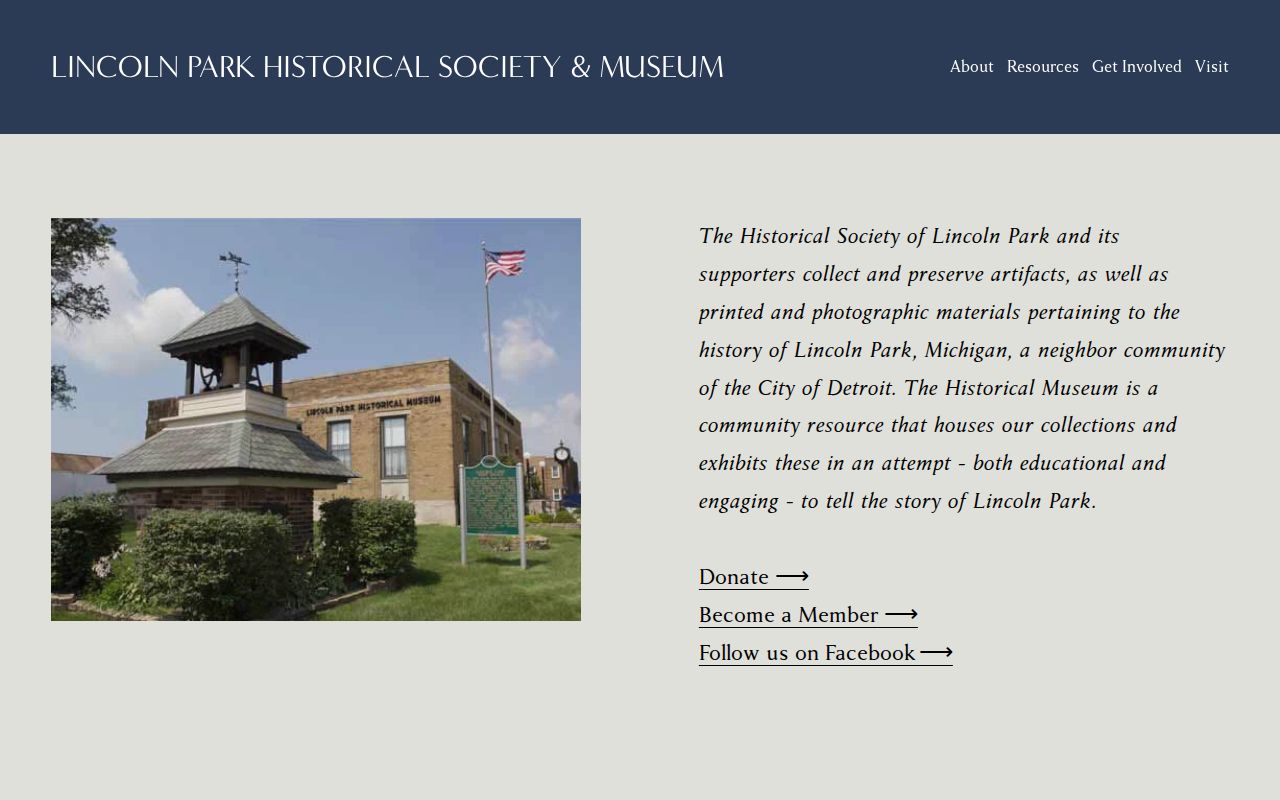
The museum’s Lost Lincoln Park work uses archival material to document vanished landmarks and changed land uses. Its website does not provide a public name index or fee schedule, so a request should give an address, family name, approximate year, or school and ask what material can be consulted.
Lincoln Park City Directory Gaps
A missing year, a blank phone field, or an absent surname is not proof that a household did not exist. The local combined volume has documented gaps, and a directory can omit a new home, a vacant address, an unlisted telephone, or a person outside the publisher’s indexing choice. The public research did not locate a full publisher title-page inventory for the entire 1941-1988 shelf. Ask for the precise Polk, Bresser, or combined Downriver year instead of assuming that every annual issue survives.
Michigan newspaper microfilm, available through the Library of Michigan and interlibrary-loan routes, is a useful bridge for a transition year. FamilySearch’s Michigan County Marriages collection can also supply relationship or residence clues for 1820-1941 where access permits.
Lincoln Park Directory Date Myth
Myth: a printed Lincoln Park directory proves that a person was at an address on the publication day. In fact, an entry places a person at an address during the publisher’s compilation period. A later move, death, marriage, or spelling change can make the book look inconsistent with another record. The remedy is simple: compare adjacent directory years and use a released census, deed, obituary, or local archive item to test the date.
Directories remain powerful because they preserve names and addresses that other records may not organize together. They work best when each entry is treated as one dated piece of a larger local-history trail.